Friday, 23 February 2018

Barnbougle Lost Farm, Bridport, Tasmania

https://barnbougle.com.au

Mens' Terracotta (Boobyalla) par 78 (20 holes), SSS 71 (18 holes), 6102 metres
Ladies' Blue (Melaleuca) par 79 (20 holes), SSS72 (18 holes), 5338 metres

Take a flight from Melbourne to Launceston in Tasmania and then drive for about one and a half hours north and you will arrive at the golfing haven of Barnbougle.  Set on the north east coast of Tasmania there are two beautiful true links courses, Barnbougle Dunes and Barnbougle Lost Farm.  The complex, although smaller, is reminiscent of Bandon Dunes in Oregon which is testament to the fact that the developer Richard Sattler had advice from the Bandon Dunes founder Mike Keiser.  Barnbougle is named after Barnbougle Castle on the shores of the river Forth near Edinburgh, the home of the original owners.  The second of the two courses,  Lost Farm was named after a portion of the original farming land which became surrounded by sand dunes and was designed by Bill Coore and Ben Crenshaw, the architects of Bandon Trails.


The 3rd hole at Lost farm
We played Lost Farm on a warm, calm but wet day  The course is on classic links land, with large sand dunes reminiscent of many British or Irish courses but only a few glimpses of the sea or of adjacent holes.  The fairways were wide but the rough was suicidal marram grass, guaranteed to swallow up a stray ball. The greens were less fast than they appeared, possibly because of the rain, but all of them were sloping making many putts very difficult to read.  With a total of 20 holes this is an unusual course.


The first memorable hole is the 3rd which is a short par 4 on the side of a sand dune with a large bunker threatening the drive in the middle of the fairway.  The green is steeply contoured so it is essential to keep the ball below the pin, as in most of the greens.  With a lovely view from an elevated tee overlooking the dunes to Barnbougle Dunes the 4th is the first of the strong well bunkered par 3s on this course,  Hidden behind a huge sand dune with a bunker at its base, the drive at the 5th is blind to a curving fairway leading to an elevated green.  The 6th is another par 3 with a long carry to the green and some impossible pin positions, especially behind the bunker guarding the right side.  The next few holes were pleasant but not really memorable until the 11th where there appears to be a wall of bunkers awaiting the drive.  The 12th is a par 5 which doglegs to the left, followed by the 13th with its green nestled in a hollow between sand dunes.

The 4th is guarded by a large bunker short
13a, one of the extra holes

Then comes the first of the extra holes, 13a which is another well bunkered par 3 from an elevated tee.  Another big carry faces the player at the 14th tee which is a short par 4 with a green protected by runoffs.  The 15th is a par 3 sheltered in the dunes but with great views of the beach and overlooked by the restaurant at Lost Farm which must be one of the most scenic golf club restaurants in the world with a wall of glass overlooking the course and Anderson Bay.  Do not be distracted by the views as the green is a tricky back to front sloping one where a 3 putt is easily achieved.  The 16th and 18th are long par 4s, separated by another strong par 3.  The final extra hole is 18a which is a par 3 with lots of bunkers and a viciously sloping green.
                                                                         
                              
                      The clubhouse has magnificent views

Worth playing?  A long way for us Scots to travel but worth every mile.

Tuesday, 20 February 2018

Port Fairy Golf Links, Port Fairy, Victoria, Australia

www.portfairygolf.com.au

Blue tees par 72, SSS (ACR) 72, 5887 metres
Red tees par 72, SSS (AWCR) 72, 5063 metres


Port Fairy Golf Links lie on a spit of land between Port Fairy Bay in the Bass Strait and a lagoon called Belfast Lough on the south coast of Victoria.  The bay was named by the crew of a whaler 'The Fairy' in 1828 and the town was briefly named Belfast between 1854 and 1887, hence the two names.  To the west of the course lies the town of Port Fairy, which is a convenient stopping place at the end of the scenic Great Ocean Road.  The original course was in the town but by 1963 nine holes were in operation on the present site, followed by an 18 hole course in 1985.  Significant changes were made in 2000 by Michael Clayton who describes Port Fairy Golf Links as being 'largely unaltered by man and only mown to define fairways and rough'.
 

The 3rd hole turns into the dunes
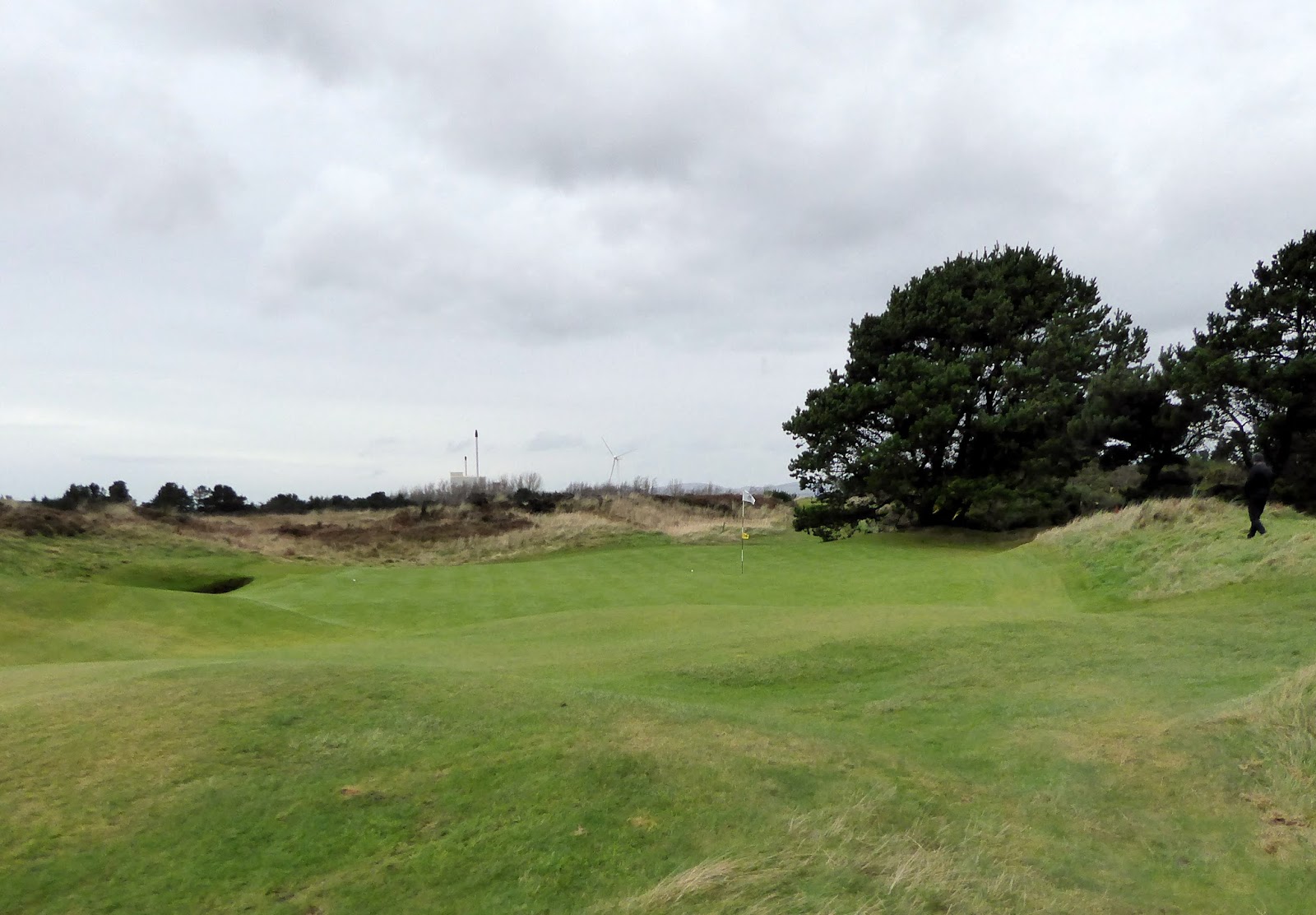
We played Port Fairy on a sunny but windy day and found a delightful and scenic true links course.  There are five holes on the flatter ground outwith the dunes - the 1st, 2nd, 9th, 17th and 18th which are somewhat disappointing but when the course turns into the dunes at the par 4 3rd hole it comes into its own.  The par 5 5th is a classic links hole well bunkered and winding uphill to a sloping green on the side of the dunes.  The outstanding holes are along the ocean with views of the Bass Strait.  These are the 12th to 16th holes and are all proper links holes, made more difficult by being into the prevailing wind.  Our only criticisms of these holes would be that the par 4 14th and par 3 15th holes would be improved by some bunkering around the greens.  At the farthest end of the course the 16th is a dogleg from right to left to an elevated green which has the Belfast nature reserve as a close out of bounds on the right.
Looking back down the 12th hole

.  Worth playing?  Yes, a lovely links course.  Stay at Oscars Waterfront in Port Fairy and have dinner at Conlan's.

Wednesday, 14 February 2018

The Cut, Dawesville, Western Australia

www.the-cut.com.au

Blue tees par 72, SSS (ACR) 73, 6077 metres
Red tees par 72, SSS (ACR) 74, 5209 metres

The Cut golf course lies on a spit of land bordered on one side by the Indian Ocean and on the other by the Peel Harvey estuary just south of Mandurah in Western Australia.  It is a modern course, built in 2005 and designed by James Wilcher. This course has a split personality – part true links and part Mediterranean style.  We played it on a warm, sunny and inevitably windy day and enjoyed the fast running undulating and tilting fairways, the fast greens with subtle borrows and the fabulous views of the Indian Ocean.  

Holes 1 to 4 are true links holes with fairways meandering through the natural sand dunes.  The 1st has a fairly easy drive although placement is key.  Anything to the left leaves an almost impossible approach shot up a steep slope to a high sloping green.  We thought it was reminiscent of the 1st hole at North Berwick (20/11/14).  The next three holes follow the coast with stunning views of the ocean.  The 2nd and 3rd are typical well bunkered par 4s although the 3rd is a real risk and reward hole, tempting the longer hitters to attack the green with their drive but risking bunkers or a blind shot from behind the dune which protects the green on the right. 
The first few holes follow the Indian Ocean

Turning inland the character of the course changes, with the 5th to 9th holes being probably the weakest and least links-like holes on the course.  The second nine has more true links holes.  The 11th is a challenging par 4 with another elevated green where the approach shot is blind.  It is memorable for me as when I reached the green I realised I had holed my second shot for an eagle 2.  The 12th is the most spectacular hole on the course, a narrow hole running through sand dunes to an elevated sloping green with beautiful sea views and played into the prevailing wind.  The 15th is a par 5 with green nestled in a hollow to the right which was blind from most of the fairway.  Unusually this green had no surrounding bunkers.  Sitting on the highest point of the course the 16th tee  plays downhill to a green guarded by a large sand dune to the right.  This results in an easy hole when the pin is placed at the front of the green and an almost impossible hole when the pin is back right.  The last two holes thread their way back through the dunes to the modern clubhouse.


Looking back from the 12th green (above) and a view of the course
from the highest point at the 16th tee (below)


Worth playing?  Yes - a lovely course in excellent condition in an idyllic setting, it is mostly a true links course.


Monday, 12 February 2018

The Links at Kennedy Bay, Port Kennedy, Wetsern Australia

www.kennedybay.com.au

Blue tees par 72, SSS (ACR) 72, 6107 metres
Red tees par 72, SSS (ACR) 74, 5274 metres

The Links at Kennedy Bay lies south of the city of Perth just outside Port Kennedy on the Indian Ocean coast. Opened in 1998 it was designed by Michael Coate and Roger Mackay with input from Ian Baker-Finch, the 1991 Open champion.  The course has been closed twice since because of financial problems but re-opened in 2008.  Fortunately the second period of closure was only for five months which minimised any effect on the course.

First impressions are not good as the clubhouse leaves a lot to be desired but the friendly staff assured us that there are plans for a new development including a hotel.  The course itself is a delight, winding through sand dunes with numerous challenges.  The fairways are fast running but tight with dense thickets of scrub close to the edges. The greens are gently sloping and surrounded by swales to catch even a slightly errant shot.  The 115 bunkers on the course are fed by the slopes on the fairways making them difficult to avoid but we were disappointed with the quality of the sand which was hard packed and most unlike links sand.  Although the Indian Ocean can be heard at the far end of the course it cannot be seen which is a pity as views of the ocean would have added appeal.

                                         
Five bunkers guard the 6th green


We played Kennedy Bay on a warm sunny day, accompanied by the constant south westerly wind.  Although there were many good holes, few are particularly memorable.  The par fours are strong and well bunkered.  The 5th is a good example.  Named 'Thread the Needle' it narrows progressively between bunkers to a green shared with the 7th.  The 7th itself is a short par 4 which might tempt the longer hitter to go for the green but the bunkering and the steep run offs around the green make it much more difficult than it appears at first sight.  The 15th is a lovely par 4 up a valley but into the prevailing wind.  Avoid the left side where there is a blind shot to the green which lies in a bowl and is quite forgiving to the approach shot.  Probably the best hole on the course is the par 3 16th, 'Wee Tap'.  It is only
123 metres from the blue and 104 metres from the red tees but the shot is to a narrow green guarded by a bunker on the left and a deep swale on the right with a prevailing right to left wind.  The course finishes with a strong par 5 which needs three good shots to the well guarded green and a final well bunkered par 4.

'Wee Tap', the challenging par 3 6th
Worth playing?  Yes - the truest of the true links course in Western Australia

Sunday, 11 February 2018

Seaview Golf Club, Cottesloe, Western Australia

 www.seaviewgolfclub.com.au

Blue tees par 71, SSS (ACR) 70, 5564 metres
Red tees par 72, SSS (ACR) 73, 4998 metres


Today was the start of the Australian odyssey - seven true links courses in three weeks.  We started at Seaview Golf Club which is at Cottesloe on the beautiful coastline north of Perth, Western Australia.  The golf course opened in 1909 and was designed by founder members NC Fowlie and Peter Anderson.  A Scot from Forfar, Anderson won the British Amateur Championship in 1893 which he followed by tying for 19th place in the Open championship in the same year.  Both were played at Prestwick, an iconic true links course.  Initially the course was owned by the Cottesloe Golf club which moved to a new course in 1931, when Seaview Golf Club was formed.
A view of the Indian Ocean from the 7th green

We played Seaview on a warm and sunny summer day but buffeted by the Fremantle Doctor, the nickname for the strong south-westerly breeze which blows in the afternoon. It is a nine hole course which disappointingly is not really a true links course.  Although by the sea with lovely views of the Indian Ocean and built on sandy soil the course does not have hard and fast running fairways and has a substantial number of Norfolk pines throughout.  The greens are slow and attempting a running shot inevitably leaves the ball short.  The bunkers are shallow and not as challenging as the revetted bunkers of a true links course.  There are no truly memorable holes - most are fairly short and there are no doglegs.
The par 3 8th

Worth playing?  A fun holiday course if you are in the area but don't go out of your way - it is not a true links.


Wednesday, 8 November 2017

Gailes Links, Irvine, Scotland

www.gaileslinks.co.uk

White tees SSS 72, par 71, 6535 yards               
Blue tees SSS 68, par 71, 5553 yards


Not to be confused with Western Gailes, its neighbour to the south, Gailes Links lies south of the town of Irvine close to the estuary of the River Clyde.  It is run by the Glasgow Golf Club which is the 9th oldest club in the world, being inaugurated in 1787.  It remains an all male club, so the course is not rated for ladies. 

The Gailes links first opened for golf in 1892 when the rising popularity of golf resulted in overcrowded courses in Glasgow and the club moved out to the Gailes linksland.  Members travelled by train from Glasgow to Irvine and then walked two miles to the course before a new station was built to serve the course.  The original layout was redesigned by Willie Park in 1911.  His design remains today with the exception of lengthening of the course from the championship tees to 6903 yards.
The original Ballochmyle red sandstone clubhouse was opened
in 1894 and is still in use today

Gailes Links is a traditional Scottish links course with heather and gorse lined fairways.  It is fairly flat and there are no sea views although the island of Arran can be seen on the horizon.  We played it with Lynn and David Lawson (and Maisie our cairn terrier) on a dull breezy day.  The fairways were rather soft for a true links course perhaps because of recent heavy rain.  The greens were unusually slow but had challenging and subtle slopes.  The prevailing wind is westerly and therefore across for most of the holes.

The 5th green nestles in a dell
The course starts with four par 4 holes which are traditional links holes but not particularly memorable.  The 5th is a challenging par 5 with excellent bunkering and a green nestled in a hollow.  This is followed by the only par three of the first nine whose green is well guarded by mounds and pot bunkers.  Two par 4s follow both with elevated greens sloping from front to back before the course turns for home.  The second nine has six par 4s which are a good mix of lengths.  The only par 5 on this nine is the 14th where heather, gorse and the Glasgow to Stranraer railway line await a sliced drive.  The green is approached over a large ridge with bunkers at either side and is guarded by pot bunkers to the right and left.  The best and most memorable holes in this nine are the two par 3s.  The 12th is a long carry over gorse to a steep plateau green and the 15th, although shorter, has two well placed bunkers to the right and a deep swale to the left.
The par 3 12th with its plateau green

Worth playing?  Yes - it is a fair test of golf though overshadowed by its more famous neighbours Royal Troon and Turnberry.

Friday, 23 June 2017

Falsterbo Golf Club, Sweden

www.falsterbogk.se

White tees par 71, slope 129, 6157 metres
Red tees par 71, slope 129, 5001 metres

Falsterbo is situated on the southernmost tip of Sweden where the Baltic Sea meets the Oresund.  The club was founded in 1909 but for the first two years golf was played to the east of the current course until nine holes designed by Robert Turnbull, Copenhagen's golf professional, were opened in 1911.  In 1930 the course was expanded to eighteen holes by Gunnar Bauer, a local doctor, at which time horses and cattle were banned on the course.  The only change since then was the rebuilding of the green complexes in the late 1990s.  Falsterbo has hosted a number of professional tournaments, most recently a Challenge Tour event in 2003. 
The clubhouse with the 9th green
in the foreground

On arrival at Falsterbo the first impression is of peace and quiet - it is situated in a nature reserve established for its rich flora and fauna and in particular because of the large numbers of migrating birds..  We had a friendly welcome in the quintessentially Swedish timbered clubhouse which dates 
back to 1914 and availed ourselves of the advice to go to the first floor and admire the views across the sea to Denmark.  The Falsterbo lighthouse, built in the late 18th century on the site of the oldest known beacon in Scandinavia, dominates the course.

The 1st to 6th holes are on the inland side of the course in a wetland area.  As a consequence there are a number of water hazards and the fairways and greens do not have the typical hard and fast running nature of links greens.  However the rest of the course is a typical links course and the whole is a pleasure to play.  The hazards are the many bunkers (nine greenside on the 7th and sixteen on the 9th hole) and the punishing rough which appears benign from afar but not when a shot has to be played from it!  The 11th is a standout par 3 with water
The 11th green is almost totally
surrounded by water

surrounding the green on three sides.  Concentration is required not just for the shot to the green but also to cross the narrow wooden bridge from the tee to the green.  The course then turns to run alongside the sea  The 12th is the only blind drive over a ridge but is a lovely hole heading towards the lighthouse.  The par 5 13th is a bit contrived around the lighthouse and will punish a slice which results in a blind second shot.  The 14th has the lighthouse as a backdrop and is a tricky par 3 with a difficult green to hold. 

There is then a delightful finishing stretch with the 16th green and 17th tee being in the tip of the peninsula.  The 18th hole is a lovely short par 5 with its green nestled in sand dunes next to the clubhouse. 
The Falsterbo lighthouse behind the 14th green


Worth playing?  Yes.  It is in a beautiful area
.

Thursday, 22 June 2017

Viken Helsingborg Golf Club, Sweden

www.helsingborgsgk.com

Yellow tees par 68, slope 112, 4542 metres
Red tees par 68, slope 118, 4144 metres

Helsingborg golf course lies between the lovely old village of Viken and the Oresund, which is the strait between Denmark and south-west Sweden.  To get here we flew to Copenhagen and then crossed the Oresund Bridge which links Denmark and Sweden and is the longest combined road and rail bridge in Europe.

The thatched sheep shelter which was
built for a rescue boat and later
accommodated the club repair shop.


The course is set out on a narrow slip of links land on fairly flat terrain with views over to Helsingor in Denmark.  Golf was played on the land in the late 19th century but it wasn't until 1924 that the course was opened.  It was designed as a nine hole course by William Hester from Hoylake, Liverpool who had been the Professional and greenkeeper at Falsterbo from 1912 and who trained Sweden's first golf professionals.  The greenkeeper told us that the course has not changed since then and aims to be as close to playing golf in the 1920s as possible.  We even saw some players with hickory shafted clubs.
The 6th green with Denmark on the horizon

We played with Lynn and David Lawson on an overcast summer's day with a light breeze.  The tees are mats, the fairways are somewhat worn but the greens were in good condition althoug perhaps not as hard and fast running as classic links greens.  Fortunately the course was quiet as a number of holes cross each other which must give rise to a lot of shouts of 'fore!'.  There are no particularly memorable holes but some quirky ones, which is probably a good description of this club.  The clubhouse is delightful and feels as if it hasn't changed since the 1920s with many historical photographs and an honesty box.

The black timbered clubhouse overlooks the 9th green
Worth playing - Yes if you are in the area for the step back in golfing time.

Saturday, 27 May 2017

Rhyl Golf Club, Wales

www.rhylgolfclub.co.uk

White tees par 71, SSS 71, 6315 yards
Red tees par 73, SSS 71, 5559 yards

Rhyl Golf Club lies on the North Wales coast to the east of the town of Rhyl, once an elegant Victorian resort which unfortunately declined in the late 20th century.  It was designed by James Braid and opened in 1890, leading to a claim to be Wales' oldest golf course. 


The 2nd green with the town of Prestatyn in the background
Rhyl is a nine hole course which lies on links land but is very flat.  There are few contours and no views of the sea because of a ridge which runs the length of the course,  Unfortunately the inland side is dominated by a large and rather noisy holiday park which runs the length of the course.  We played on a windy but dry day and were disappointed by the quality of the course.  The fairways although fast running were poor and the tees worn and infested by weeds.  The greens had clearly been watered and were slow and lush, not in keeping with a links course.  It has four holes out and five holes back but none were particularly memorable.
The course is bordered by a large holiday park

Worth playing?  No


Friday, 18 November 2016

Dunbar Golf Club, Dunbar, Scotland

www.dunbar-golfclub.co.uk

White tees par 71, SSS 72, 6597 yards
Red tees par 72, SSS 73, 5696 yards

Golf is first recorded in Dunbar in 1616 when golfers were reprimanded by the Church for playing on the Sabbath (Sunday).  This was probably on the West Barns Links which was the course where the Dunbar Golfing Society was inaugurated in 1794.  The Dunbar Golf Club was formed in 1856 prompted by the opening of a railway in 1846 and the establishment of a military barracks in 1855.  After 'clearing of the ground' (which suggests that there was no pre-existing course) the East Links was formed as a fifteen hole course which lay to the seaward of the wall which runs between the current 4th and 18th holes.  An eighteen hole course was set out in 1880 with four further alterations being done over the years by such illustrious names as Old Tom Morris, James Braid and Ben Sayers.  The course was extended to its current length in 2008.
'Jackson's Pennies', the well bunkered 3rd green with the old deer wall in the background

Dunbar is a typical classic links course which runs more or less straight out and straight back.  All but four of the holes (1st, 2nd, 3rd and 18th) lie on the seaward side of an old red sandstone deer park wall between it and the rocky coastline.  We played the course with Norma Richmond in a team event on a windy day.  It starts with two fairly ordinary par 5s on the landward side of the wall followed by a tricky and punishingly bunkered par 3 named 'Jackson's Pennies' after a former member who used to spend all day betting pennies on whether players would hit the green.  The path from the 3rd to the
4th goes through the old wall and the player is greeted by magnificent views of the Forth estuary and its islands which can be seen from every hole and this is where the true links nature of the course starts.  Hugging the coastline the 4th is a lovely par 4 which on first sight looks easy but beware the fast and undulating green.  After a testing par 3 the 6th and 7th follow the old deer wall which punishes a slice with an out of bounds penalty.  The 7th is even more testing as it is a dog leg to the right over the crest of a hill to a downhill green between the wall and an old boathouse.  The 9th hole will also punish a slice with a blind drive and the wall on the right.
Looking back to the town of Dunbar from the 4th green
with the Bass Rock in the distance

At the 11th the course turns for home and there is a run of three excellent par 4s from the 12th to the 14th.  The 12th stands out as a testing hole which doglegs slightly left to right to an infinity green with water awaiting an errant shot to the right.  The 14th heads back towards the old boat house and is framed by a lovely view of the Bass Rock.  The homeward run of holes are just as much fun with a tricky par 3 at the 16th and the 17th green close to the wall.  The 18th is back on the landward side of the wall but again a slice will flirt with out of bounds.  Dunbar is not a happy course for the chronic slicer!

This is a difficult course for ladies with only one par 4 being less than 300 yards but it is a links course of quality with tight lines, fast running fairways and true greens.  It stands out for its views of the sea which are lacking in many links courses.
Looking back up the 12th hole - there is trouble on the right!

Worth playing?  Yes