Friday, 25 February 2022

Littlehampton Golf Club, Kent, England


White tees par 70, slope 123, 6207 yards                                    
Red tees par 73, slope 126, 5615 yards

We played Littlehampton on a sunny but breezy day in late February having driven down from Royal Cinque Ports past the white cliffs of Dover.  Littlehampton lies on the south coast of England overlooking the English Channel.  Incorporated in 1889 it was originally a nine hole course in the sand dunes but in 1893 more land was purchased to add a further nine holes. As with many courses in this area it was ravaged during World War 2 but after the removal of over 400 concrete blocks and a military road the course was restored.

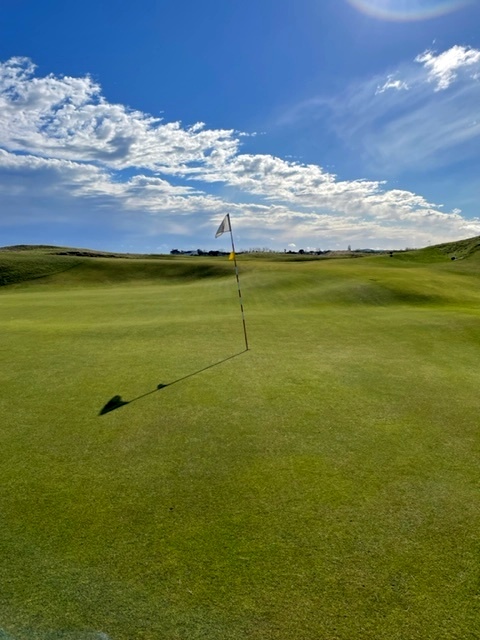
The first hole

This is an unassuming but very friendly club.  We met some very helpful members at the start who insisted that we join them in the clubhouse after the round for a Littlehampton 'special' - brandy and lovage. 

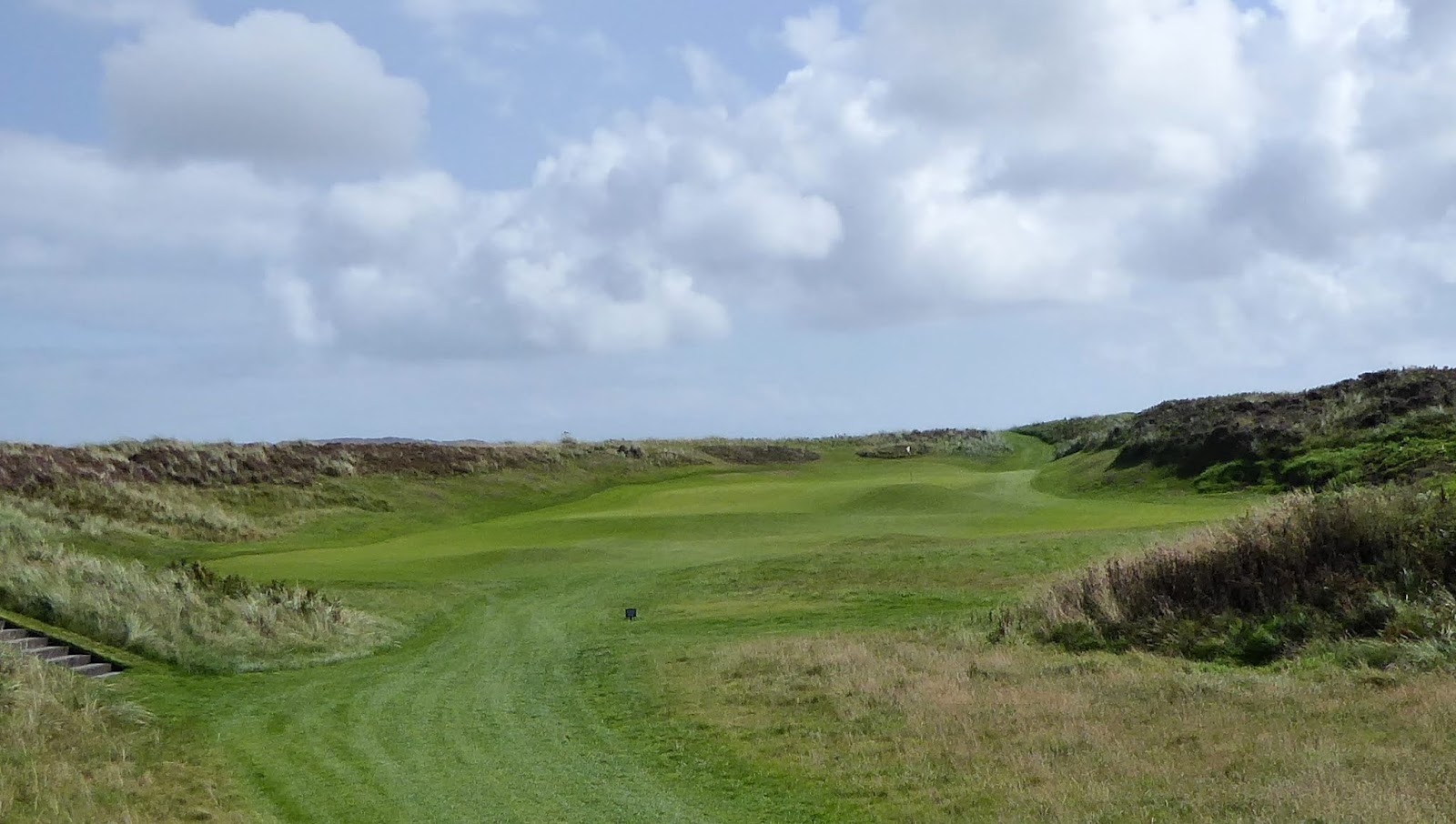
The second hole is a typical links hole
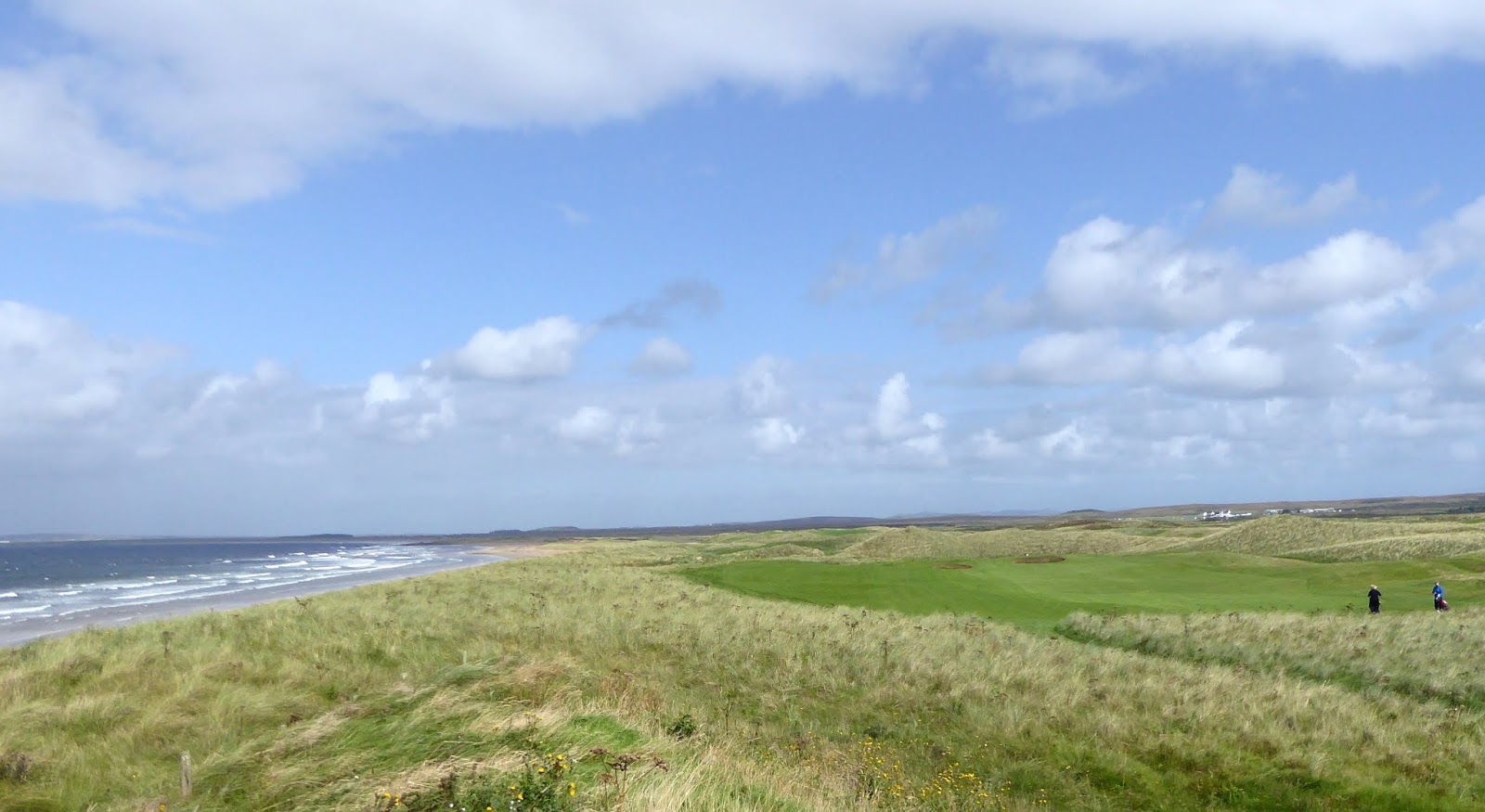
Improvements to the course are underway to build more sand dunes on both sides of the first hole to tie in with the original sand dunes running along the coast.  The prettiest section is along the dunes with occasional glimpses of the magnificent sandy beach.  Standout holes include the second, sixth and seventh, which are typical links holes and easy on the eye.  The sixth is a long par 3 with bunkers awaiting the unwary and a sloping green. The seventh is a gentle dog leg to the right with views of the sea from the tee.  The second nine is less interesting with a few rather wet holes but a nice finishing hole by the clubhouse


The long par 3 6th
Glimpses of the sea on the first nine


Worth playing?  Yes for the relaxing course and friendly welcome.


Thursday, 24 February 2022

Royal Cinque Ports Golf Club, Deal, England


White tees 73.9, slope 129, 7010 yards
Red tees 73.3, slope 124, 5660 yards

Initially Cinque Ports golf club, this course lies on the same stretch of coast as Royal St George's and Princes' golf clubs.   The cinque ports are a mediaeval confederation of five English Channel ports to provide ships and men for the king's service.  The title probably dates from the time of Edward the Confessor in the 11th century for defence of the coast and cross channel passage.  In return the inhabitants were give a number of privileges including exemption from tax.  Cinque Ports golf club was opened in 1892 as a nine hole course, much of which would still be recognisable today.  It was designed by the first professional, Henry Hunter,  who was also responsible for its conversion to an eighteen hole course in 1895.  The course received royal patronage just before the coronation of George V but the title of royal was not formally granted until 1949.  Royal Cinque Ports has hosted the Open Championship on two occasions, in 1908 and 1920.

Looking across the first hole to the clubhouse

 This is a lovely proper links course with a friendly         welcome.  We played with our son William and   encountered challenging conditions with  windy weather   and  some heavy wintry showers.  Despite the winter   weather the course was in excellent condition with fast   running crumpled fairways and greens in superb   condition. Its difficulty is increased by the prevailing   wind which blows across the line of play of the course   rather like the Old Course in St Andrews.


Crumpled fairways on the third hole
The first hole is a gentle par 4 heading south with a burn guarding the green.  The course then turns to the north and the next eight holes run along the coast overlooking the English Channel with occasional glimpses of the sea.  We particularly liked the third hole, a par 5 with the second shot through a narrow gap and a green in a hollow.  This was followed by a par 3 with a sloping green and views of Ramsgate in the distance .   Other memorable holes include the 6th with a very undulating fairway and a plateau green and the tenth which was a dogleg from right to left with a large bunker to discourage the player from cutting the corner and steep runoffs round the green.  The 14th hole also had deep swales around the green at the front left and back with a pot bunker guarding the right side making this long par 3 particularly tricky.  The finishing hole is reminiscent of the first, being a gentle par 4 with a burn across the fairway.

The dogleg 10th protected by
 a well positioned bunker

Ramsgate can be seen in the
distance beyond the par 3 4th 
                            

Worth playing?  Definitely.  A proper true links course.


Wednesday, 23 September 2020

Royal St George's Golf Club, Sandwich, Kent, England

www.royalstgeorges.com

Medal tees par 70, SSS 72, 6630 yards
Pinto (forward) tees ladies par 74, SSS 75, 5801 yards

Our first true links course since the Coronavirus lockdown!  Founded in 1887 by Dr William Purves, Royal St George's was intended to be a rival to St Andrews and held the first Open Championship outside Scotland in 1894 and in some ways time seems to have stood still since then at the club.  It is held in high regard in golfing circles with the battle for the Claret Jug having been held here on fourteen occasions with the 15th due to be held in 2021.  


We played the course on a windy day with the occasional shower of rain.  The course was very quiet, presumably because there are no overseas visitors.  This is a tough course with long carries even from the standard tees and especially for ladies from the forward tees and has many blind or partially blind
The bunkerless 3rd hole

shots.  We were told that the club only has four lady members and this is obvious in the layout of the course - the line to the fairway from one forward tee is blocked by a bench!  The male oriented nature of the course is highlighted in the stroke saver where the name of the 6th hole, the Maiden, is attributed to the shape of the two dunes behind the green.  Perhaps this should be updated.

The course starts with two fairly gentle par 4s, although the carry from the first tee is quite long.  The third is a par 3 which s reputedly one of the most difficult par 3s on the Open rota despite the absence of bunkers.  The green is typical of most with many slopes and runoff areas.  At the fourth there is a much photographed large bunker which looms in front of the golfer from all but the forward tees.  A successful drive leads to a fairway with big slopes and a green which is very tricky with slopes and ridges punishing the slightly errant shot.  A climb up to the fifth tee is rewarded by a lovely view across Sandwich and Pegwell Bay to the white cliffs at Ramsgate.  The fifth and the eighth fairways both have rough in the middle which are a challenge to carry with a strong wind against.

The second nine is considered tougher, probably because the many of the holes face the prevailing
The par 3 6th - 'The Maiden'
wind.  There are five par 5s for ladies in this nine.  The 11th is an attractive and inviting par 3 although bunkers lie on either side to gather any shot slightly off line.  A slight dogleg from left to right, the 12th is the shortest par 4 on the course and has a green heavily guarded by bunkers in front.  With out of bounds along the right the par 5 14th is famous for Dustin Johnson's inexplicable slice out of bounds in the final round of the 2011 Open which cleared the way for Darren Clarke's victory.  Seven bunkers surround the par 3 16th where Thomas Bjorn took three strokes to get out of one of them thereby losing the 2003 Open to Ben Curtis.  The course finishes with two long classic links holes into the prevailing wind.
The 11th hole has views across the bay to Ramsgate


Befitting an Open venue this is a difficult links course  but it lacks the 'wow' factor of the Ailsa at Turnberry and the cleverness of Royal Birkdale.

Worth playing?  Yes as an Open venue but bring your 'A game' and plenty of golf balls.


Saturday, 14 September 2019

Southerness Golf Club, Southerness, Dumfries, Scotland

https://southernessgolfclub.com/

Blue tees 6709 yards, par 69

Red tees 5604 yards, par 73

Lying on the north bank of the Solway Firth at the entrance to the Nith estuary, Southerness golf course is opposite Silloth on Solway golf course and due south of Dumfries.  It was built in 1946 by a local landowner, Major Richard Oswald, and designed by Mackenzie Ross, the first president of the British Association of Golf Architects.  It is notable as being one of the few clubs in which women have had voting rights since its founding.

Southerness is a classic true links course.  Framed by the Southern uplands to the north with lovely views to the mountains of the Lake District to the south, there are good views of the Solway Firth especially at the 12th and 13th.  We played it on a bright and breezy day.  It is fairly flat with hard and fast running fairways and greens and lots of gorse and heather bordering many of the holes. The first three holes are classic links holes and are challenging par 4s bordered by heather and gorse which head away from the clubhouse and into the prevailing wind. The first par three is the 4th which is uphill to a

The fourth green has a backdrop of
the Southern Uplands

tricky two tiered green with runoffs especially to the right and bunkers front, right and left.  An uphill par 5 follows in the opposite direction and with the prevailing wind.  It is a slight dogleg to the left with a burn on the right and left at the corner which is underground as it crosses the fairway.  The 6th turns back into the wind but is downhill and has the burn crossing it which can catch a long drive or a poorly hit second shot when the wind is against.  A long par three follows from which there is the first sight of the Solway Firth.  The first nine is completed by two lovely par fours again bordered by gorse and heather and well bunkered.

There are lovely views from the 12th green

The second nine starts with a par three with a green at an angle to the tee and well guarded by bunkers.  The course then heads out along the Solway Firth on the right with some lovely views of Southerness beach and the Lake District in the distance.  The 11th is a short par 4 with an elevated green sloping from back to front and guarded by a burn crossing in front of the green.  The dogleg par 4 12th opens out to a green which has a pond to the left, bunkers to the right and out of bounds long.  The view of Southerness beach is distracting as is the possibility for nature lovers of spotting great crested newts in the pond.  This is the most memorable hole on the course.  The 13th is a long par 4 for men and a par 5 for women which heads towards the Southerness lighthouse, the second oldest lighthouse in Scotland and the emblem of the club.  The course then turns for home with another long par 4/par 5 followed by a par 3 featuring bunkers to the right and left of the green and gorse to punish a long shot.  The 17th is a tricky par 3 with no bunkers but an elevated green which is difficult to hold.  Failure to stay on the green is punishing with deep swales to negotiate.  The course finishes with a par 5 lined by heather and a green overlooked by the clubhouse.
The 13th green with the Southerness lighthouse in the background

Worth playing?  It's worth going out of your way to play this course

Monday, 29 October 2018

Humewood Golf Course, Port Elizabeth, South Africa

humewoodgolf.co.za

White tees par 72, S.A.G.A. 71, 6096 metres
Red tees par 74, W.G.S.A. 73, 5350 metres

Lying to the south east of the city of Port Elizabeth on Algoa Bay in the Indian Ocean, Humewood Golf Course is the only true links course in Africa.  In 1929 golf was becoming popular in the area, probably due to an increasing European influence, and the Port Elizabeth Golf Club commissioned Colonel Stafford Vere Hotchkin who remodelled Woodhall Spa golf course in Lincolnshire, to design a new course which opened two years later in 1930 as Humewood Golf Course.

The view from the clubhouse over the 18th green to the
1st fairway and the Indian Ocean


We played Humewood on a perfect day with light winds.  The members, from whom we had a very friendly welcome, told us that there are three courses - one in the east wind, one in the west wind and one like today!  The course is a true links topographically although the turf was rather lush in places and the fairways although typically undulating, were not as hard and fast running as we would expect.  The course starts with two straightforward par 4s with raised greens which we came to realise are a feature of the course, punishing any slightly short approach shots.  The four par 3s are all excellent tests of golf, not least of which is the third which is 190m from the white tees and may need a driver in strong winds.  The par 3 sixth was described by Retief Goosen as 'the shortest par 4 in the world' and reputedly had an average score of 5.2 in a tournament when the wind was blowing. The 12th requires an accurate tee shot to a long narrow green guarded by bunkers.  The final par 3 is the 14th
The approach to the 13th green
which is played to a plateau green sloping from back to front and guarded by a bunker short left and a hidden bunker on the right. 
The par 4s are no less challenging.  Four are particularly long - 4,8,10 and 13.  The 13th is particularly memorable with a typically crumpled fairway leading to an elevated and sloping green.  The course finishes with the par 4 18th heading back to the clubhouse over a very sloping fairway and a green well guarded by bunkers.  An added attraction of the course is the prolific wildlife - we saw ibis, mongoose, cape grysbok and blacksmith plovers to name but a few.

The par 3 14th hole.  There is a hidden bunker on the right


Worth playing?  Yes - it's the only true links in Africa!


Thursday, 23 August 2018

The Machrie, Islay, Scotland

https://www.campbellgrayhotels.com/machrie-islay-scotland/golf/

Blue tees par 72, SSS 70, 6309 yards
Yellow tees par 72, SSS 70, 5104 yards

The Machrie Golf Course lies on the south west coast on the inner Hebridean island of Islay.  The name is a corruption of the Gaelic 'machair' which means fertile plain but is used to describe the dune grassland on which true links courses are built.  Originally designed by Willie Campbell from Musselburgh in 1891 three years before he left for the USA to become head professional at Brookline Country Club, it was modified by Donald Steel in the 1970s.  The course was renowned for its number of blind shots and traditional layout but unfortunately ran into financial difficulties.  It was rescued in 2011 and completely redesigned by architect DJ Russell who widened the fairways, eliminated many but not all of the blind shots and placed a premium on shot placement.
The second hole is protected by
the Kintra burn on the left

The fifth green lies in a dell
We hadn't played the course for more than thirty years and were interested to try the new layout which has received largely positive but mixed reviews. Accompanied by golfing friends Marc and Beth Swiontkowski we played on a breezy and showery but clear day with lovely views over Laggan Bay.

The fairways are wide but stray off them and you will find punishing rough and probably lose your golf ball.  There are many undulations and swales on the fairways and on and around the testing greens but only five bunkers on the whole of the course.  The starting hole is a gentle left to right dogleg with a wide fairway but don't be lulled into a false sense of security as the second hole is a testing par 5 with the Kintra river running along the length of the hole on the left.  Turning along the coast with views to the Rinns of Islay over Laggan bay the par three third has two of the bunkers on the course guarding the front of the green which slopes from left to right.  The 5th is one of the few remaining blind tee shots over a large dune to a lower tier of fairway.  The second shot is downhill to a receptive green nestled in the dunes.  A short par 4, the 7th is a hogsback fairway with a large dune guarding the right side of the green so placement of the drive is paramount.  The eighth runs up a valley to a plateau green tilted from back to front and with a deep narrow gully short. The traditional links shot cannot be played as any shot not landing on the green will run backwards into the gully.  The first nine is completed by a simple unbunkered par three facing the ocean.  It would probably benefit from some strategically placed bunkers.
Looking down the 6th fairway to the Rinns of Islay


A shot to the eighth green needs to carry 
the whole way or risk ending up in 
the gully short of the green
Turning back for home the Machrie burn runs along the left side of the par 4 10th but a good line to the green is on the left half of the fairway requiring some flirtation with the water.  A short par 4 which is potentially driveable follows with a sloping and tiered green.  The 14th is another par 3 which would benefit from bunkering but has a testing two tier green.  The 17th is a short par 4 with a tight dogleg to the right to a green in a dell.  It is the perfect example of how important placement of the drive is on the Machrie to avoid blind shots to the green.  The 18th is a rather featureless long par 5 running uphill back to the hotel which we also felt would be improved by bunkering. 

 All in all the Machrie is an honest links course without pretensions to be what it is not.  It is an excellent links course which can be enjoyed by all levels of amateur golfers.
The 14th green has two tiers but no bunkers

Worth playing?  Definitely - perfect holiday golf for all levels of golfer.


Friday, 23 February 2018

Barnbougle Lost Farm, Bridport, Tasmania

https://barnbougle.com.au

Mens' Terracotta (Boobyalla) par 78 (20 holes), SSS 71 (18 holes), 6102 metres
Ladies' Blue (Melaleuca) par 79 (20 holes), SSS72 (18 holes), 5338 metres

Take a flight from Melbourne to Launceston in Tasmania and then drive for about one and a half hours north and you will arrive at the golfing haven of Barnbougle.  Set on the north east coast of Tasmania there are two beautiful true links courses, Barnbougle Dunes and Barnbougle Lost Farm.  The complex, although smaller, is reminiscent of Bandon Dunes in Oregon which is testament to the fact that the developer Richard Sattler had advice from the Bandon Dunes founder Mike Keiser.  Barnbougle is named after Barnbougle Castle on the shores of the river Forth near Edinburgh, the home of the original owners.  The second of the two courses,  Lost Farm was named after a portion of the original farming land which became surrounded by sand dunes and was designed by Bill Coore and Ben Crenshaw, the architects of Bandon Trails.


The 3rd hole at Lost farm
We played Lost Farm on a warm, calm but wet day  The course is on classic links land, with large sand dunes reminiscent of many British or Irish courses but only a few glimpses of the sea or of adjacent holes.  The fairways were wide but the rough was suicidal marram grass, guaranteed to swallow up a stray ball. The greens were less fast than they appeared, possibly because of the rain, but all of them were sloping making many putts very difficult to read.  With a total of 20 holes this is an unusual course.


The first memorable hole is the 3rd which is a short par 4 on the side of a sand dune with a large bunker threatening the drive in the middle of the fairway.  The green is steeply contoured so it is essential to keep the ball below the pin, as in most of the greens.  With a lovely view from an elevated tee overlooking the dunes to Barnbougle Dunes the 4th is the first of the strong well bunkered par 3s on this course,  Hidden behind a huge sand dune with a bunker at its base, the drive at the 5th is blind to a curving fairway leading to an elevated green.  The 6th is another par 3 with a long carry to the green and some impossible pin positions, especially behind the bunker guarding the right side.  The next few holes were pleasant but not really memorable until the 11th where there appears to be a wall of bunkers awaiting the drive.  The 12th is a par 5 which doglegs to the left, followed by the 13th with its green nestled in a hollow between sand dunes.

The 4th is guarded by a large bunker short
13a, one of the extra holes

Then comes the first of the extra holes, 13a which is another well bunkered par 3 from an elevated tee.  Another big carry faces the player at the 14th tee which is a short par 4 with a green protected by runoffs.  The 15th is a par 3 sheltered in the dunes but with great views of the beach and overlooked by the restaurant at Lost Farm which must be one of the most scenic golf club restaurants in the world with a wall of glass overlooking the course and Anderson Bay.  Do not be distracted by the views as the green is a tricky back to front sloping one where a 3 putt is easily achieved.  The 16th and 18th are long par 4s, separated by another strong par 3.  The final extra hole is 18a which is a par 3 with lots of bunkers and a viciously sloping green.
                                                                         
                              
                      The clubhouse has magnificent views

Worth playing?  A long way for us Scots to travel but worth every mile.

Tuesday, 20 February 2018

Port Fairy Golf Links, Port Fairy, Victoria, Australia

www.portfairygolf.com.au

Blue tees par 72, SSS (ACR) 72, 5887 metres
Red tees par 72, SSS (AWCR) 72, 5063 metres


Port Fairy Golf Links lie on a spit of land between Port Fairy Bay in the Bass Strait and a lagoon called Belfast Lough on the south coast of Victoria.  The bay was named by the crew of a whaler 'The Fairy' in 1828 and the town was briefly named Belfast between 1854 and 1887, hence the two names.  To the west of the course lies the town of Port Fairy, which is a convenient stopping place at the end of the scenic Great Ocean Road.  The original course was in the town but by 1963 nine holes were in operation on the present site, followed by an 18 hole course in 1985.  Significant changes were made in 2000 by Michael Clayton who describes Port Fairy Golf Links as being 'largely unaltered by man and only mown to define fairways and rough'.
 

The 3rd hole turns into the dunes
We played Port Fairy on a sunny but windy day and found a delightful and scenic true links course.  There are five holes on the flatter ground outwith the dunes - the 1st, 2nd, 9th, 17th and 18th which are somewhat disappointing but when the course turns into the dunes at the par 4 3rd hole it comes into its own.  The par 5 5th is a classic links hole well bunkered and winding uphill to a sloping green on the side of the dunes.  The outstanding holes are along the ocean with views of the Bass Strait.  These are the 12th to 16th holes and are all proper links holes, made more difficult by being into the prevailing wind.  Our only criticisms of these holes would be that the par 4 14th and par 3 15th holes would be improved by some bunkering around the greens.  At the farthest end of the course the 16th is a dogleg from right to left to an elevated green which has the Belfast nature reserve as a close out of bounds on the right.
Looking back down the 12th hole

.  Worth playing?  Yes, a lovely links course.  Stay at Oscars Waterfront in Port Fairy and have dinner at Conlan's.

Wednesday, 14 February 2018

The Cut, Dawesville, Western Australia

www.the-cut.com.au

Blue tees par 72, SSS (ACR) 73, 6077 metres
Red tees par 72, SSS (ACR) 74, 5209 metres

The Cut golf course lies on a spit of land bordered on one side by the Indian Ocean and on the other by the Peel Harvey estuary just south of Mandurah in Western Australia.  It is a modern course, built in 2005 and designed by James Wilcher. This course has a split personality – part true links and part Mediterranean style.  We played it on a warm, sunny and inevitably windy day and enjoyed the fast running undulating and tilting fairways, the fast greens with subtle borrows and the fabulous views of the Indian Ocean.  

Holes 1 to 4 are true links holes with fairways meandering through the natural sand dunes.  The 1st has a fairly easy drive although placement is key.  Anything to the left leaves an almost impossible approach shot up a steep slope to a high sloping green.  We thought it was reminiscent of the 1st hole at North Berwick (20/11/14).  The next three holes follow the coast with stunning views of the ocean.  The 2nd and 3rd are typical well bunkered par 4s although the 3rd is a real risk and reward hole, tempting the longer hitters to attack the green with their drive but risking bunkers or a blind shot from behind the dune which protects the green on the right. 
The first few holes follow the Indian Ocean

Turning inland the character of the course changes, with the 5th to 9th holes being probably the weakest and least links-like holes on the course.  The second nine has more true links holes.  The 11th is a challenging par 4 with another elevated green where the approach shot is blind.  It is memorable for me as when I reached the green I realised I had holed my second shot for an eagle 2.  The 12th is the most spectacular hole on the course, a narrow hole running through sand dunes to an elevated sloping green with beautiful sea views and played into the prevailing wind.  The 15th is a par 5 with green nestled in a hollow to the right which was blind from most of the fairway.  Unusually this green had no surrounding bunkers.  Sitting on the highest point of the course the 16th tee  plays downhill to a green guarded by a large sand dune to the right.  This results in an easy hole when the pin is placed at the front of the green and an almost impossible hole when the pin is back right.  The last two holes thread their way back through the dunes to the modern clubhouse.


Looking back from the 12th green (above) and a view of the course
from the highest point at the 16th tee (below)


Worth playing?  Yes - a lovely course in excellent condition in an idyllic setting, it is mostly a true links course.


Monday, 12 February 2018

The Links at Kennedy Bay, Port Kennedy, Wetsern Australia

www.kennedybay.com.au

Blue tees par 72, SSS (ACR) 72, 6107 metres
Red tees par 72, SSS (ACR) 74, 5274 metres

The Links at Kennedy Bay lies south of the city of Perth just outside Port Kennedy on the Indian Ocean coast. Opened in 1998 it was designed by Michael Coate and Roger Mackay with input from Ian Baker-Finch, the 1991 Open champion.  The course has been closed twice since because of financial problems but re-opened in 2008.  Fortunately the second period of closure was only for five months which minimised any effect on the course.

First impressions are not good as the clubhouse leaves a lot to be desired but the friendly staff assured us that there are plans for a new development including a hotel.  The course itself is a delight, winding through sand dunes with numerous challenges.  The fairways are fast running but tight with dense thickets of scrub close to the edges. The greens are gently sloping and surrounded by swales to catch even a slightly errant shot.  The 115 bunkers on the course are fed by the slopes on the fairways making them difficult to avoid but we were disappointed with the quality of the sand which was hard packed and most unlike links sand.  Although the Indian Ocean can be heard at the far end of the course it cannot be seen which is a pity as views of the ocean would have added appeal.

                                         
Five bunkers guard the 6th green


We played Kennedy Bay on a warm sunny day, accompanied by the constant south westerly wind.  Although there were many good holes, few are particularly memorable.  The par fours are strong and well bunkered.  The 5th is a good example.  Named 'Thread the Needle' it narrows progressively between bunkers to a green shared with the 7th.  The 7th itself is a short par 4 which might tempt the longer hitter to go for the green but the bunkering and the steep run offs around the green make it much more difficult than it appears at first sight.  The 15th is a lovely par 4 up a valley but into the prevailing wind.  Avoid the left side where there is a blind shot to the green which lies in a bowl and is quite forgiving to the approach shot.  Probably the best hole on the course is the par 3 16th, 'Wee Tap'.  It is only
123 metres from the blue and 104 metres from the red tees but the shot is to a narrow green guarded by a bunker on the left and a deep swale on the right with a prevailing right to left wind.  The course finishes with a strong par 5 which needs three good shots to the well guarded green and a final well bunkered par 4.

'Wee Tap', the challenging par 3 6th
Worth playing?  Yes - the truest of the true links course in Western Australia